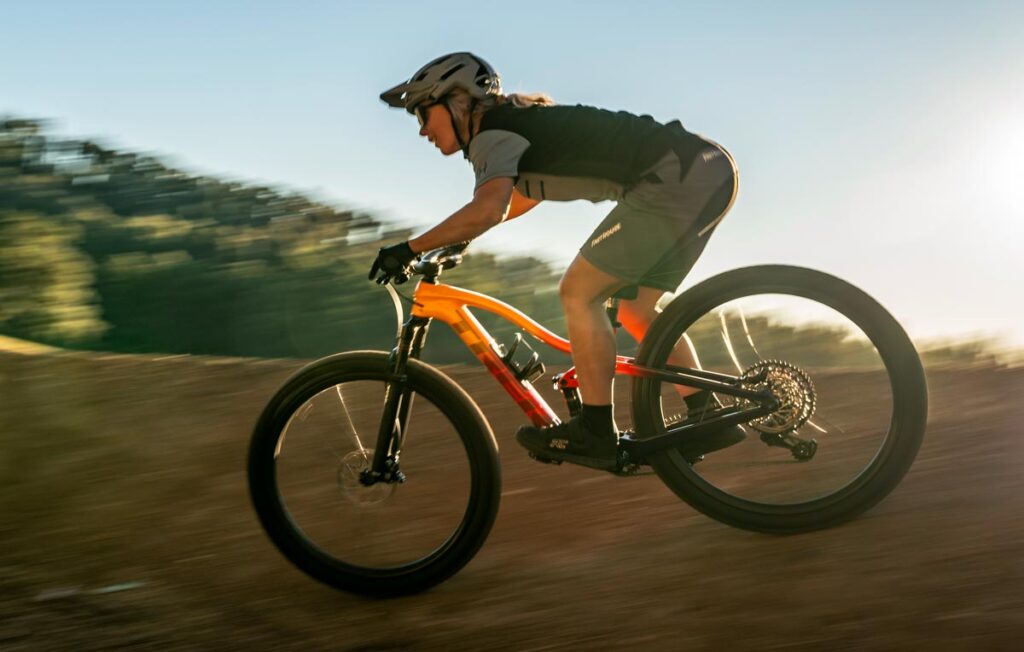
Mountain bikes differ from normal bikes in many ways: they are designed to withstand rough terrain with a stronger frame, wider and rougher tyres and a wider gear range. The geometry of the mountain bike is also different, providing better control over rough terrain. These features make mountain bikes ideal for riding on trails and nature trails, without being best suited to flat roads.
What makes a bike a mountain bike?
Mountain bike recognised by its strong frame, more upright steering angle and lower saddle in relation to the handlebars. The frame is built to withstand shocks and vibrations, so it is typically thicker and stronger than a standard bike frame.
The geometry is designed for driving stability on uneven terrain. The wheelbase is longer for better balance and the centre of gravity is lower. The handlebars are usually straighter and wider than on a city bike, giving better control.
Many mountain bikes are equipped with suspension at the front or both ends. Front suspension absorbs shocks and improves comfort on rough terrain. Full-suspension mountain bikes are particularly suitable for technical riding and downhill driving. Check out VMSport's wide range of mountain bikes and find the model that suits you!
How do mountain bike tyres differ from normal tyres?
The tyres on a mountain bike are much wider and rougher than those on normal bikes. Widths typically range from 2-3 inches, while city bike tyres are often 1-1.5 inches wide.
Illustration is the most important feature of mountain bike tyres. Deep knobs and aggressive tread pattern provide grip on mud, sand and rocks. Different patterns are designed for different conditions: deep side knobs for cornering, centre knobs for straight-line driving and compound patterns for all-round use.
The material is stronger and thicker than that used in normal tyres. The sidewalls are more resistant to punctures and impacts. Many mountain bike tyres are designed to run at lower pressures for better grip and comfort.
Why do mountain bikes have so many spokes?
Mountain bikes need a wide gear range because the terrain varies from steep uphill to flat sections and fast downhill. Typically, a mountain bike has 10-12 rear and 1-3 front derailleurs, for a total of up to 30 different gear combinations.
The small cogs allow light pedalling on steep uphill gradients, while the large cogs provide speed on flat terrain and downhill gradients. Switching area is much wider than on conventional bikes, which means a greater difference between the lightest and heaviest gears.
Modern mountain bikes often use a 1x gear system (single front sprocket), which simplifies shifting while maintaining sufficient gear range. This reduces mechanical problems and facilitates maintenance. See VMSport's modern mountain bikes and their advanced gear systems!
When should you choose a mountain bike instead of a regular bike?
A mountain bike is a better choice if you plan to ride regularly on nature trails, forest roads or uneven terrain. It's also great if you want one bike for both urban riding and camping.
Choose a mountain bike if you live in an area with a lot of gravel roads or if you plan to ride in winter. Wide tyres and a strong frame are better able to cope with challenging conditions than delicate city bikes.
Normal bike is enough if you drive mainly on asphalt roads, cycle paths or in an urban environment. It's lighter, faster on flat surfaces and requires less maintenance. The price is also generally cheaper.
Mountain bikes offer versatility and durability, but are heavier and slower on tarmac. Think about your purpose: if you want the freedom to ride anywhere, a mountain bike opens up new cycling possibilities. Find the mountain bike of your dreams at VMSport and start your adventure in nature!